Monday, July 15, 2013

God Revealed Through Creation


There are few places I enjoy more than Ketchum/Sun Valley, Idaho.  It just so happens to be where our family is spending the week, thanks to the generosity of some wonderful people.  The community and surrounding area is something special.  It's difficult to look out our back door, behold the sight of the Smokey Mountains of Idaho, the Big Wood River, and various hiking trails and bike paths, and not think about the Creator of all that is.  I am in awe.  Perhaps you've experienced the same when you've been in the mountains or at the beach?

On Sunday, we had the opportunity to worship at the Presbyterian Church of the Big Woods.  No less than three Presbyterian Senior Pastors from other churches attended the 9:30 service.  I guess I'm not the only one who loves the area!  During the service, there was a group from Africa who led the worship singing.  They were fantastic!  They sang with incredible passion and, in the rich tradition of African worship, did a little dancing as well.  I think my hips may have swiveled on more than one occasion...unintentionally!

You can imagine my spiritual high.  Worshipping God in the midst of some beautiful country. It doesn't get any better than that, does it?  And then...

The guest preacher for the morning was introduced, and he stood up to address the congregation.  Don Schoendorfer is the founder and president of Free Wheelchair Mission (http://www.freewheelchairmission.org).  Their mission is to "provide the transforming gift of mobility to the physically disabled poor in developing countries, as motivated by Jesus Christ."  I was startled to hear that 80% of people with disabilities live in developing countries.  That number is staggering when you consider most of those people are without aid. During the message, he read a brief passage from the ninth chapter of John.  He then proceeded to show a video of residents in a village in Ghana.  Their mission group had arrived, and word quickly spread that they were giving away free wheelchairs.  To see so many people come, dragging themselves in the dirt or walking with the assistance of a staff was quite a sight.  The hope of mobility compelled them to come forward and they did so with great dignity.


In chapter nine of the Gospel of John, Jesus and his disciples encountered a man disabled by blindness.  The disciples pose to Jesus a question, inquiring as to who is to blame for his disability: "Rabbi, who sinned, this man or his parents, that he was born blind?" (9:2, NIV)

Isn't that the question that most of us ask, when we see a person who is suffering, disabled, poor, ill, etc?  Basically, we want to know who is to blame?  We tend to think of it as punishment for some misdeed.  Truth be told, some people who fall on hard times do so because of the poor choices they make.  There is no question.  For the person who was born disabled, however, their situation is not due to a poor "choice."  We tend to get frustrated with and ascribe blame to God when it happens to someone we love.  Why did you do this to him?

Jesus responds: "Neither this man nor his parents sinned... but this happened so that the works of God might be displayed in him.  As long as it is day, we must do the works of Him who sent me.  Night is coming, when no one can work.  While I am in the world, I am the light of the world." (John 9:3-5)

Jesus is not interested in ascribing blame.  The reality is we live in a broken and fallen world.  He is interested, however, in speaking about the purpose for which He came into the world.  Jesus is led by the Father to offer a sign that He is indeed the light of the world.  Specifically, He healed the blind man and through this miracle, demonstrated His authority and identity: the Savior of the world.
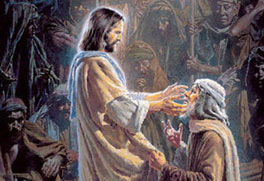

Our sufferings are always opportunities for God's grace to be revealed.  In the midst of the darkness, the light of Jesus can and does shine.  His compassion preceded the miracle, and we are to have the same compassion.  Elsewhere in the Gospel of Matthew, Jesus articulates the expectation He has for His followers to be bearers of His light.

"You are the light of the world... In the same way, let your light shine before others, that they may see your good deeds and glorify your Father in heaven." (Matthew 5:14-15)

Here's the lesson I learned in a nutshell:  Although God is revealed in the majesty of His creation: the mountains, rivers, oceans, etc., He is more clearly revealed through the compassion we extend to those who suffer, as we are the incarnational presence of Jesus to the world.  Both are equally beautiful!

Have a revealing week!

Saturday, July 6, 2013

Leadership Like Saul or David?


On Sunday, I am traveling to Spokane to take part in the inaugural cohort of the Elder Leadership Institute (http://www.whitworth.edu/ELI/), led by Sara and Jim Singleton, Jerry Sittser, and Steve Macchia.  Two ruling elders, our clerk of session, and my wife, Margaret, will be attending with me, along with others from several churches.

As part of our preparation for this one week intensive, our group has read through and discussed the book Unleader: The Surprising Qualities of a Valuable Leader by Jane Overstreet.  The author compares and contrasts the leadership styles of Saul and David from the Old Testament.  Suffice it to say, Saul is lifted up as the not-so-stellar example while David is lifted up as the leader to emulate.  The difference between the two is that Saul's efforts are not in alignment with God, and David, although flawed just like any other human, continually seeks God's guidance and glorification.  Saul pursues his own agenda while David pursues God's, and his leadership flows from his relationship and intimacy with God.

We have had some great discussions about this book, as you might imagine.  Specifically, we engaged in conversations about how we, as leaders in the Church, can better live into the "old" new, biblical model of leadership.  This is a continuation of a journey and exploration about leadership that began with our church's working with TAG Consulting (more on that in a future post!).

Overstreet's book offers some very helpful questions for one to think about one's own leadership style, and to answer the main question posed to the reader, "Does My Leadership Look More Like Saul's or David's?"  Our group agreed that these questions are relevant, not just for those who are in leadership positions within a church, but also for anyone who supervises, oversees, and simply works with others.  The questions are as follows:

  • Do I fear people more than God?
  • Do I use up or build up people under my leadership?
  • Do I put my interests before God's interests?
  • Do I lead with integrity?
  • Do I let people get close enough to really love me?
  • Do I lead from the security of knowing God's love?

These questions have been convicting and encouraging at the same time.  We have been challenged to think about leadership through the lens of the Bible.  We have begun to understand leadership as an extension of the relationship and intimacy we have with God.  We have also talked about incorporating what we have learned/will learn into our elder selection/training at First Presbyterian Church of Yakima.  

I hope that you might find them useful.  They have certainly primed us for helpful conversations.  It should be a great week!


Wednesday, July 3, 2013

Not All Who Wander Are Lost...


Back when I was an Associate Pastor (2004-2005) at the First Presbyterian Church of Nashville, Tennessee, I created this blog and intended it to be an outlet for thinking and writing.  The daily grind of pastoral ministry took up much of my time and energy in those days...and the blog dropped to the bottom of my priority list.  Although I tried once again in 2009 to resurrect the blog, it has taken me some time to find a regular rhythm to everyday life.  Part of that entailed understanding how I am wired.

Two years ago and as part of a consultation with TAG Consulting, I took the Strength Finders survey and discovered that two of my top five "strengths" are INPUT and LEARNER.  Thus, I learned that I am energized by studying, reading, and writing.  In fact, I love to process ideas out loud or on a keyboard.  When I do have the occasion to write, I never quite have the destination in mind.  I am encouraged by the wisdom of Tolkien's Gandalf when he wrote, "Not all...who wander are lost..."  Whether it's hiking, driving, or writing, I love to wander.

So, here we go again...Hopefully, the third time is the charm!

I hope to regularly write on this blog, especially as I now have been ordained for over nine years and am into my sixth year serving as Senior Pastor of the First Presbyterian Church of Yakima, Washington.  I have failed and succeeded.  I have cried and laughed.  At times, I have loved being a pastor, and other times, I am ready to become a park ranger.  All of these experiences have contributed to my maturation. Simply put, I have had much to process...

I would love it if you would "wander" with me!


Tuesday, April 28, 2009

Send in the Clowns


Pastor Jack or Bozo the Clown?

Five years ago, I attended an ordination service for a friend from seminary. The interim senior pastor of the church, The Rev. Dr. William N. Jackson, offered the sermon for the occasion. The sermon was based on Paul’s first letter to the Corinthians: “We are fools for the sake of Christ” (1 Corinthians 4:10a). In that letter, Paul is offering a “fatherly admonition” to the Corinthians, contrasting the life of an apostle with the lives of those of the church in Corinth. They had become too proud of their faith and maybe a bit judgmental of others. Paul attempts to knock them off their pedestal!

Paul’s words are a healthy reminder to all of us. We become content with our faith. We are comfortable with where we are in our walk with God. Often, the Christian thing-to-do is not always the most popular and Paul challenges us to move beyond our comfort zone. For this reason, we are called to be “fools for the sake of Christ.” Dr. Jackson offered his take on this Scripture and suggested that the word fool could also be interpreted as clown. The analogy of the clown is fantastic! While “fool” carries a very negative connotation, the “clown” encompasses a richer understanding. Using “clown” he speaks of what is entailed in being a “fool” for Christ:

1. The clown/fool for Christ’s sake does the unexpected; the extraordinary, the unusual.
2. The clown/fool for Christ’s sake does things for the good of others.
3. The clown/fool for Christ’s sake does what he or she does in loving vulnerability.
4. The clown/fool for Christ’s sake does what he or she does celebrating life

Do these sound like the characteristics of your life? It’s contrary to our natural tendencies, where we seek to serve ourselves and operate out of comfort. God’s Word, however, continually challenges us to move out of our comfort zones and do the unexpected, love our neighbors, humble ourselves, and celebrate the Life that has graciously given to us! God’s Word challenges us to be clowns for Christ’s sake, with everything that entails.

Dr. Jackson ended his sermon with a tale regarding a conference when he was speaking on this very passage from 1 Corinthians 4. Before he offered the closing prayer, a young woman began to play on her guitar the tune of that Broadway song, “Send in the Clowns." Spontaneously, and through God’s Spirit, she sang this:

“All through the world, all throughout life, people seek answers to sin, freedom, and strife. Send in the clowns. We are the clowns. Send in the clowns.”

We are the clowns. Send in the clowns. Amen!

Friday, April 17, 2009

Lead On...

St. Patrick

This week is quite a contrast from the events of Holy Week!  I am not scheduled to preach and, in fact, getting ready to travel to Nashville for The Outreach Foundation board meeting.  Apart from being part of what is, no doubt, going to be enriching conversations, I am also looking forward to seeing some old friends.  Margaret and I lived in Nashville and the first Presbyterian Church of Nashville was my first ordained call.

 It is truly amazing how God leads us through life.  Right out of seminary, we were called to Nashville, then we were called back to Texas, and now we are answering His calling to Washington.  Going back to Nashville this week reminds me that it is not my plans, but God’s plans that we are to follow.

In the spirit of reverence, devotion, and righteousness, I wanted to share something with you. The words are at attributed to an ancient Irish poem written by Dallan Forgaill dating back to the 8th century and translated from ancient Irish to English by Mary E. Byrnel in 1905. Unlike the version that exists in our current Presbyterian hymnal, this version includes all of the original verses. It is my favorite hymn and I hope it points you to the wonderful way of Jesus Christ!


Be Thou my Vision, O Lord of my heart;

Nought be all else to me, save that Thou art

Thou my best thought, by day or by night,

Waking or sleeping, Thy presence my light.


Be Thou my Wisdom, and Thou my true Word;

I ever with Thee and Thou with me, Lord;

Thou my great Father, I Thy true son;

Thou in me dwelling, and I with Thee one.


Be Thou my battle shield, sword for the fight;

Be Thou my dignity, Thou my delight;

Thou my soul's shelter, Thou my high tower:

Raise Thou me heavenward, O Power of my power.


Riches I heed not, nor man's empty praise,

Thou mine Inheritance, now and always:

Thou and Thou only, first in my heart,

High King of Heaven, my Treasure Thou art.


High King of Heaven, my victory won,

May I reach Heaven's joys, O bright Heaven's Sun!

Heart of my own heart, whatever befall,

Still be my Vision, O Ruler of all.

Monday, April 6, 2009

Final Thought... Reflections on Egypt Part 4

One final thought about Egypt and then I’d like to move on to another topic. The city of Luxor is incredible. 25% of the world’s antiquities are found there. This was my first trip there, even though it was my second trip to Egypt (We went to Sinai instead on our last trip!). It doesn’t take much to imagine what the ancient Egyptian civilization looked like. The Temple of Carnac is immense. The Luxor Temple, although not nearly as large, is equally impressive. The Valley of the Kings, located on the west side of the Nile, is incredible. Because of the dry desert climate, much has remained as it was over 3,000-4,000 years ago, at least to a certain extent.

Even though they have stood up well, they are ruins. The civilization is gone, only preserved in museums all over the world. The ancient gods of the pharaohs are no longer worshiped, but studied by historians and archaeologists.

I discovered that there is a reason the pyramids and tombs of ancient Egypt are on the west side of the Nile. It is because that is the side on which the sun sets. The god “Ra” is depicted as the sun, so when it sets, it signifies death. Interesting, right? The ancient Egyptians were very much concerned with the afterlife. In fact, once the pharaoh assumed position, he set the workers to task, building his pyramid or tomb, and all of his treasure to take with him into the afterlife.

Anyway, I couldn’t help but think of our own church building. What do you think people will say about it 1,000, 2,000, or even 4,000 years from now? Will there even be a church building or a world for that matter?

I said last time that the church is not the building, but rather the church is the followers of Jesus. Don’t get me wrong, many wonderful and life transforming events take place in the church, particularly in the sanctuary. But I think the question of whether or not there will be a church building is a moot point.

We don’t worship buildings or idols, no matter how sentimental we may be toward them. We worship a living God who is active and present in our everyday lives and is very concerned that we live, not just for the afterlife, but that we are agents of His kingdom here on earth! That means that we live out our faith in our everyday lives.

As the ancient Egyptians worked to build their own access into the afterlife, we, as believers in Jesus, celebrate that access has been provided for us. Let me leave this topic by offering you the words of truth that come to us in the Gospel John: “For God so loved the world that he gave his only Son, so that everyone who believes in him may not perish but may have eternal life” (3:16).


Thursday, April 2, 2009

Kasr El Dobara Evangelical Church... Reflections on Egypt Part 3


One of the great experiences we have when visiting Egypt is to take time and speak to the folks at the Kasr El Dobara Church, the largest protestant church in all of the Middle East. The people of the church treat us with great kindness and hospitality. There is no telling how many people grace the doors of the church on any given week. One thing is clear, however, and that is the church is steeped in a rich history and service. One way to describe the church would be faithful people are being blessed by a faithful God! I couldn't help but think of these words. If you've read Tent to Tower, you know their origin. These are words from Dr. Mark Koehler at our own church's 75th anniversary back in 1960.

The Delta Presbytery of the Synod of the Nile planted the Kasr El Dobara Church back in 1940. The Rev. Ibrahim Said was elected as the church's first pastor. He was called the "golden mouthed preacher," which referred to his eloquence and his mastery over words. (No one, to date, has called me a "golden mouthed preacher," nor do I expect they ever will!) The church was given a permit by the king of Egypt in 1944, and they built a beautiful building and sanctuary (pictured above). Ask them to talk about the history of the church, however, and they won't tell you about the building or even the sanctuary, but rather, they want to share about the real church, the faithful men and women of the congregation, who seek to follow God and His direction.

The folks at Kasr El Dobara are doing innovative things. They are considered "progressive" when compared to the rest of the denomination, in terms of their ministries. Are they about the latest church ministry programs? No. In their words, they are simply trying to obey God and be faithful to their Lord and Savior, Jesus Christ!

I couldn't help but think of our own church and wonder what the future entails. We are a church rooted in a great history. The sanctuary is magnificent. Everyone in Yakima knows the tower. However, a church (as our brothers and sisters in Egypt remind us) is not the building, it is the people who strive to follow Jesus, not just on Sunday mornings, but each and every day. We are a church committed to deepening our relationship with Jesus, so that we can love God and love our neighbors.

The second picture is one of a stained glass window behind the pulpit at the Kasr El Dobara Church. Clearly, it is an image of Jesus on the cross. What a beautiful reminder of who it is we follow!

During that 75th anniversary celebration of First Presbyterian Church of Yakima, Dr. Koehler went on to say, "This is our challenge for all future events and programs, that we are faithful to the glorious gospel and to the church of our Lord and Savior, Jesus Christ!" My hope and prayer is that, as we look to the future of FPC, we would have the courage and faithfulness to follow Him, wherever He might lead!